
Sustainable Packaging: What Actually Matters, Beyond the Buzzwords
Sep, 2026
Few phrases get used more loosely than “sustainable packaging.” It turns up on every pitch deck and product label, yet ask ten suppliers what it means and you will get ten different answers. For businesses genuinely trying to do the right thing, that noise is a real problem.
Demand for sustainable packaging is rising fast, and so is the marketing around it. Greenwashing, conflicting advice, and shifting regulations have made it hard to tell which choices actually reduce environmental impact and which just sound like they do. This article cuts through the buzzwords and looks at what really matters: the decisions across materials, design, manufacturing, and logistics that move the needle, rather than swapping one material for another and hoping for the best.
Sustainability Is About the Whole Lifecycle, Not Just Recyclability
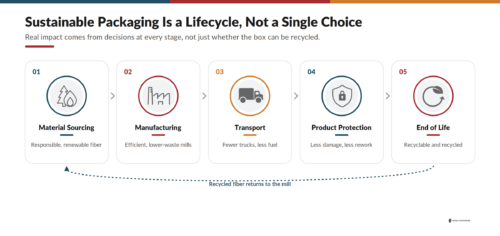
The most common mistake is treating “recyclable” as a synonym for “sustainable.” Recyclability matters, but it is one stage in a much longer story. A package’s real footprint is shaped across its entire lifecycle: how the raw material is sourced, how it is manufactured, how far and how efficiently it travels, how well it protects the product, and what happens to it at end of life.
Judge a package on any single stage and you can be badly misled. A material that recycles beautifully but tears easily, is sourced irresponsibly, or ships half-empty may do more harm than a slightly less “green” alternative that performs. Packaging sustainability is the sum of those decisions, not a label on the box. That whole-lifecycle view sits at the heart of our purpose and how we help customers make choices that hold up under scrutiny.
Material Selection: There Is Rarely a One-Size-Fits-All Answer
Materials are where most sustainability conversations start, and where most oversimplifications happen. Every option carries strengths and trade-offs, and the greenest choice on paper is not always the greenest in practice.
Paper and corrugated are renewable, widely recycled, and made largely from recovered fiber, which is why corrugated sustainable packaging is a strong default for shipping and retail. Hood’s paper mills turn recovered fiber into new container board, and that board becomes custom corrugated boxes and products. Even so, paper is not automatically green: virgin fiber from poorly managed forests, heavy coatings, and over-engineered boxes all chip away at the benefit.
Plastics are the villain of most headlines, yet they are not always the worse choice. For some products, a small amount of plastic protects the contents so well that it prevents far more waste than it creates. The aim is using the right amount of the right material, not banning a whole category on principle.
Newer eco-friendly packaging materials, from compostables to bio-based films, can help in the right setting, but many only break down in industrial facilities that most consumers cannot reach. An honest assessment of how a material behaves in the real world beats a trendy label every time.
Smarter Design Uses Fewer Resources
The most overlooked sustainability lever is not the material at all. It is the design. A box that is sized correctly, engineered to use less board, and built to protect the product first time out reduces waste long before anything reaches a recycling bin.
Right-sizing cuts material use and shipping volume at the same time. Structural design that removes unnecessary board, uses efficient flute profiles, and eliminates void fill lowers the footprint without weakening protection. Done well, packaging that uses fewer resources also costs less to make and ship, which is why good design is where sustainability and budget tend to agree.
Reducing Waste Across Manufacturing and Logistics
Two stages that rarely make the marketing copy quietly shape a package’s footprint: how it is made and how it moves. Efficient, recovered-fiber mills with careful water and energy management, plus low-waste converting, all reduce impact upstream, long before a box is ever filled.
Logistics matter just as much. Packaging that palletizes efficiently, ships flat, and fills trucks well cuts the number of loads on the road. Consolidated, well-planned contract packaging and pack-out can take cost and carbon out of the supply chain at the same time, which is exactly the kind of gain that never shows up on a single material label.
Balancing Sustainability With Performance and Cost
A sustainable package that fails to protect its product is not sustainable at all. Damaged goods, returns, and replacements create far more waste than the packaging ever saved. The most effective sustainable packaging solutions are the ones that hold up both commercially and physically.
The real work is finding the option that meets environmental goals while staying affordable and fit for purpose. That balance looks different for every product, which is why practical guidance beats blanket rules. The best sustainable packaging solutions are judged on total impact and total cost, not on one green attribute in isolation. If you are weighing those trade-offs, our consumer solutions are built around exactly that balance.
Common Sustainable Packaging Misconceptions
A few myths do more than any single bad material to steer businesses wrong. These are the ones worth retiring.
All paper packaging is sustainable. Not necessarily. Sourcing, coatings, and over-specification all matter. Responsibly sourced, right-sized recyclable packaging is genuinely sustainable; a heavy, laminated, oversized box is not, whatever it is made of.
Replacing plastic always lowers impact. Sometimes swapping plastic for paper adds weight, freight, and even product spoilage. The better question is which material protects the product with the least total impact.
Recyclable means it gets recycled. Only if local facilities accept it and it actually reaches them. Designing for how packaging is really collected matters more than printing a recycling symbol on it.
Sustainable packaging always costs more. Often the opposite is true. Right-sizing and material reduction usually take cost out as they take waste out, so the greener option can also be the cheaper one.
Sustainable Packaging Is a Process, Not a Product
There is no single “sustainable” material and no silver-bullet swap. Real packaging sustainability comes from informed, evidence-based decisions at every stage: sourcing responsibly, designing efficiently, manufacturing cleanly, shipping smartly, and protecting the product so nothing is wasted. It is a process of continuous improvement, not a box to tick.
The businesses that get it right treat sustainability, performance, and cost as partners rather than trade-offs. That is how environmentally friendly packaging earns its place in the real world: by standing up to the shelf, the supply chain, and the balance sheet all at once.
Sustainable packaging isn’t about following trends.
It’s about making smarter decisions throughout the packaging lifecycle.
Get in touch to discuss how we can help.
Sustainable Packaging FAQs
What is sustainable packaging?
Sustainable packaging is packaging designed to minimize environmental impact across its whole lifecycle, from how the material is sourced and manufactured to how it ships, protects the product, and is recycled or disposed of at end of life. It comes down to informed decisions at every stage, not a single material or label.
What makes packaging environmentally friendly?
Environmentally friendly packaging uses responsibly sourced, often recycled material, is right-sized to avoid waste, protects the product so nothing is thrown away, and can be recycled or recovered at end of life. Efficient design and transport matter as much as the material itself.
Is corrugated packaging sustainable?
Corrugated packaging is one of the more sustainable options because it is made largely from recovered fiber, is widely recycled, and is renewable. Corrugated sustainable packaging performs best when it is right-sized and responsibly sourced rather than over-engineered.
How can companies improve packaging sustainability?
Companies improve packaging sustainability by looking across the whole lifecycle: choosing the right material for the product, right-sizing and simplifying the design, working with efficient mills and converters, optimizing pack-out and transport, and measuring total impact instead of chasing single green claims.