
What Makes a POP Display Actually Work in Retail? (Backed by Real-World Examples)
Aug, 2026
Walk down any retail aisle and you can watch it happen in real time. Some displays stop shoppers mid-stride, draw them in, and move product off the floor. Others sit in a prime spot — right brand, right size, right location and somehow get walked past all day. That difference is rarely down to luck.
A point of purchase (POP) display has to do several jobs at once. It has to catch attention, communicate a brand in a few seconds, survive the daily reality of a busy store, and arrive in one piece after a long trip through the supply chain. When any one of those jobs is missed, even a beautifully designed display underperforms. Below, we break down the four things that separate retail displays that sell from the ones that fade into the background, plus the common mistakes that quietly cost brands sales.
The Four Elements of a High-Performing POP Display
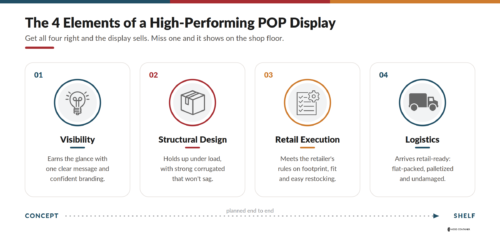
A successful display is never just about looking good on a rendering. Strong POP display design balances four elements together: visibility, structural design, retail execution, and logistics. Together, they turn a simple sheet of retail display packaging into a unit that earns its place on the floor. Get all four right and the display does its job quietly in your favor. Miss one, and it tends to show up in an obvious way with a display that collapses, gets ignored, is turned away by the retailer, or costs a fortune to ship. Here is what each element actually means once the display hits the shop floor.
- Visibility: Standing Out Without Overwhelming the Shopper
Attention is the first hurdle. A shopper decides in a couple of seconds whether a display is worth a second look, so the design has to earn that glance before it can sell anything. Strong visibility usually comes from clarity, not clutter with a clear focal point, confident branding, and a single, obvious message.
It is tempting to pack a display with every selling point, but crowded graphics and competing messages tend to cancel each other out. The POP displays that win are often the simplest: one headline benefit, clean brand recognition, and product that is easy to reach. Placement matters just as much — a unit built for an end cap behaves very differently from one designed for a checkout counter or a shelf. If a display looks fine but still is not moving product, the issue is often the message rather than the merchandise, something we cover in reasons why your retail packaging isn’t selling.
- Structural Design: Built for Retail Reality
A display can look perfect in a design file and still fail the moment it is loaded with product. Structural design is about making sure it holds up, literally. That means the right materials, honest weight-bearing capacity, and shelves or trays that will not sag or buckle over a multi-week promotion.
Corrugated is the workhorse here. Well-engineered corrugated POP displays are strong, lightweight, recyclable, and cost-effective, which is why they dominate temporary and semi-permanent retail programs. The craft is in balancing appearance with function. A piece of display packaging has to survive assembly, restocking, and a few knocks from carts without looking tired. Ease of assembly counts too: if store staff struggle to build it, it may never make it onto the floor. This is where experienced Design Services pay for themselves, engineering the display to look the part and take the load.
- Retail Execution: Designed for How Stores Actually Run
Even a striking, sturdy display fails if it ignores how the store operates. Retailers have specific requirements; footprint limits, height restrictions, safety rules, and planogram compliance and a display that misses them can be rejected before it ever reaches an aisle.
Good retail execution designs for the realities of the floor: the space a display is allowed to occupy, how easily staff can restock it, and how it sits alongside surrounding retail packaging and fixtures. The best point of purchase displays make the store’s job easier, not harder. They arrive ready to place, are simple to replenish, and hold up through the full promotion rather than needing to be rebuilt halfway through.
- Logistics: Retail Success Starts Before the Store
Retail performance is often decided long before a shopper sees the display. If it arrives damaged, incomplete, or difficult to assemble, none of the design work matters. That is why logistics is a design consideration, not an afterthought.
Smart displays are engineered to ship efficiently and arrive retail-ready — flat-packed or pre-assembled to protect them in transit, palletized to use space well, and designed to cut the labor needed to set them up in-store. Efficient Display Pack Out and Logistics planning reduce damage, lower freight costs, and get displays live faster. Getting product to the floor intact is closely tied to avoiding shipping damage, which can quietly erode the return on an entire campaign.
Looking to create retail displays that attract attention and perform in-store? Speak to our team about developing effective POP display solutions.
Common POP Display Mistakes to Avoid
Most underperforming displays fail for a handful of predictable reasons. These are the ones that come up again and again and each is avoidable with the four elements above in mind.
Designing for the boardroom, not the aisle. A display that impresses in a pitch meeting can still get lost on a crowded floor. Designs approved on a screen should be pressure-tested against real store conditions, lighting, and the neighboring brands they will actually compete with.
Ignoring the retailer’s specifications. Missing a height limit or footprint rule by an inch can mean a rejected display and a missed launch window. Retailer specs should shape the design from day one, not be checked at the end.
Underestimating the load. Displays that look great empty can sag or collapse once fully merchandised. Weight-bearing needs to be planned around the heaviest realistic load, not the empty display photo.
Forgetting the supply chain. A display designed without shipping in mind can arrive crushed or take too long to assemble. Building for pack-out and transit protects the whole investment.
Overcomplicating the message. Trying to say everything usually means the shopper absorbs nothing. One clear message will almost always outperform five competing ones.
Great POP Displays Are Planned From Concept to Shelf
The displays that stop shoppers and move product are not lucky. Successful displays are designed and planned. Visibility earns the glance, structural design makes it last, retail execution gets it approved and stocked, and logistics gets it there in one piece. The most effective point of purchase displays balance all four, treating creative design and practical performance as the same job rather than competing priorities.
That is the thinking behind every display we build, from first concept through design, pack-out, and delivery. Whether you are planning a seasonal promotion or a permanent fixture, the goal is the same: a display that looks the part and performs where it counts. Explore our Customer Solutions to see how design, structure, and supply chain come together in one place.
From design to pack-out and delivery, we help brands create POP displays that are built for retail success. Get in touch to discuss your next project.
POP Display FAQs
What is a POP display?
A point of purchase (POP) display is a standalone or shelf-based unit used in retail to promote a specific product at the moment of purchase. Also called point of purchase displays or retail displays, they range from small counter units to full floor-standing fixtures, and they are designed to catch a shopper’s attention right where buying decisions are made.
What makes a successful POP display?
A successful POP display balances four things: visibility that catches attention, structural design that holds up in-store, retail execution that meets the retailer’s requirements, and logistics that get it there undamaged and ready to sell. Strong visuals alone are not enough as the display also has to survive the store and the supply chain.
How do POP displays increase sales?
POP displays increase sales by placing a product in a high-visibility spot at the exact moment a shopper is deciding what to buy. They reinforce the brand, highlight a key benefit or offer, and make the product easy to find and reach, turning passive foot traffic into purchases.
What materials are best for POP displays?
Corrugated is the most popular material for POP displays because it is strong, lightweight, recyclable, and cost-effective. Well-designed corrugated POP displays suit most temporary and semi-permanent retail merchandising displays, while more permanent fixtures may combine corrugated with wood, metal, or acrylic for added durability.